
Table of Contents
- What Actually Drives the Value of Rare Vintage Band T-Shirts
- How to Identify Vintage Band T-Shirts: Tags, Stitching, and Print
- Most Expensive Vintage Band Shirts Sold: What the Auction Archive Shows
- The Condition Grading Scale: Mint, Deadstock, Worn-In, and Dry Rot
- Where to Sell Vintage Band Tees for the Best Return
- Reprints, Bootlegs, and Legal Sourcing: What Buyers Should Know
- Conclusion: Building a Collection Without Overpaying
- Frequently Asked Questions
Last Updated: September 11, 2026
What Actually Drives the Value of Rare Vintage Band T-Shirts
The value of rare vintage band t-shirts comes down to four things: scarcity, provenance, condition, and cultural significance. Get all four right and you're holding an investment piece. Get one wrong and you're holding a shirt.
At Tim Cosgriff Art, the question we hear most is what makes an original tour shirt worth real money. The short answer: a genuine 1970s tour tee from a legendary band, in wearable condition, with documented tour dates on the back, sits in a different category than a modern reprint with a distressed finish.
Rarity, Provenance, and the Tours That Made History
Scarcity alone doesn't create value. A shirt nobody wants is still worthless, no matter how few exist.
What matters is scarcity combined with demand. A shirt from a band's breakthrough tour, produced in limited numbers before the band was famous, carries more weight than a mass-produced arena tee from a peak-year tour. The market pays for the moment, not just the garment.
Provenance is the second lever. A documented chain of ownership, a ticket stub from the same show, or a photo of the original owner at the concert moves a shirt into a higher pricing tier, the difference between an interesting tee and a verified artifact.
Tour dates printed on the back matter enormously. A shirt listing a full North American run from a specific year tells the buyer exactly when it was made and which leg of the tour it belonged to, historical value you can date.
How to Identify Vintage Band T-Shirts: Tags, Stitching, and Print
Learning how to identify vintage band t-shirts starts with three checks: the tag, the stitching, and the print. Any one can rule a shirt in or out, but the technical layer underneath each check is where authentication actually gets decided.
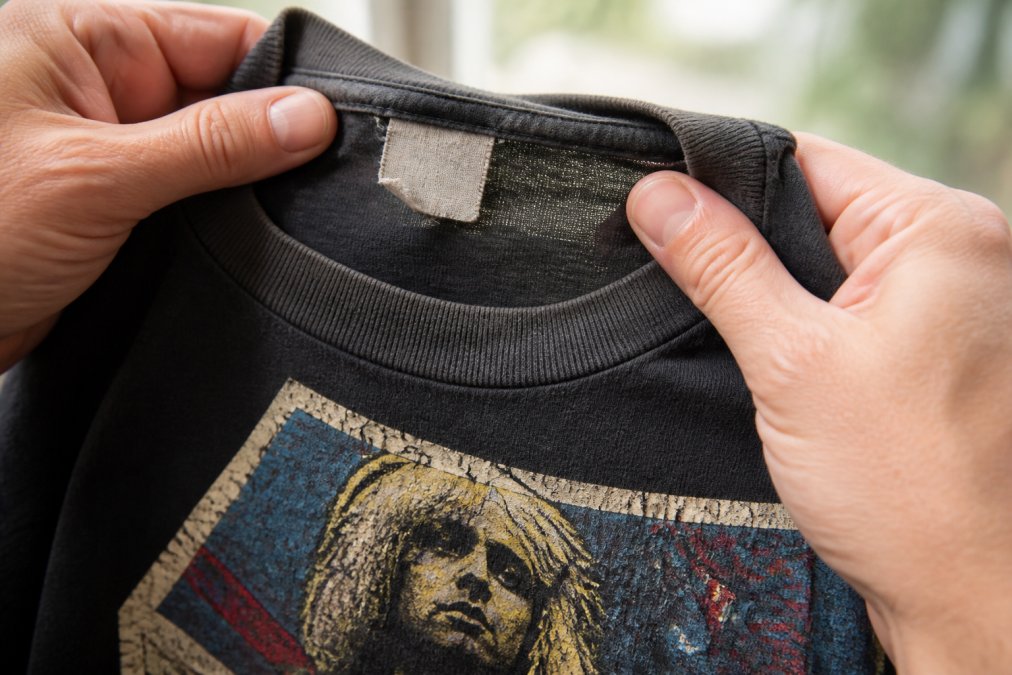
Tag Analysis: Reading the Label Like a Document
The tag is the most information-dense part of a shirt, and most buyers only glance at it. A proper tag analysis looks at four things:
- Tag construction, Paper tags, woven labels, and printed neck labels belong to different manufacturing eras. A paper tag that has yellowed and stiffened with age behaves differently from a modern reproduction printed to look aged.
- Brand and manufacturer marks, The label's brand name, size designation, and any care-instruction text all changed over time. A tag that pairs a period-correct brand with a care-instruction format from a later decade is a mismatch.
- Print method on the tag itself, Older tags were often printed with ink that fades or flakes in a characteristic way; modern tags are usually heat-transferred or woven cleanly.
- Country-of-origin and fiber content lines, These lines were added, changed, and standardized at different points, and their presence or absence helps bracket a shirt's production window.
Start with the tag. Older shirts carry single-stitch collar hems and paper or woven tags with era-specific branding; modern reprints almost always use double-stitch construction and printed neck labels. That detail eliminates most fakes in seconds.
Single-Stitch vs. Double-Stitch: The Fastest Authenticity Check
Single-stitch construction means the hem was sewn with one line of thread, standard on most shirts made before the mid-1990s (vintagefashionguild.org). Double-stitch uses two parallel lines and became the norm as manufacturing shifted.
Flip the shirt inside out and check the bottom and sleeve hems. Single-stitch on both suggests an original; double-stitch means the shirt was made later, even if the graphic looks period-correct.
This isn't foolproof. Some legitimate shirts used double-stitching earlier than others, and a skilled forger can replicate single-stitch. But combined with tag analysis and print wear, it's the fastest first filter.
Fabric Aging: What Time Actually Does to Cotton
This is the check most guides skip, and the hardest to fake. Cotton ages in ways that are difficult to reproduce:
- Softness and drape, Decades-old cotton has a broken-in softness and a specific drape that new fabric doesn't have, no matter how it's washed.
- Fading pattern, Sun and repeated washing fade dye unevenly, concentrating at shoulders, collar, and fold lines. A uniformly faded shirt is suspicious.
- Thinning and pilling, Genuine age produces thin spots, small pills, and a slight translucency when held to light. A modern shirt distressed to look worn usually has surface abrasion without the underlying thinning.
- Smell and hand-feel, Old cotton has a distinct dry, papery hand-feel and often a faint musty or storage smell that doesn't wash out completely.
Print Wear: How Screen Ink Fails Over Time
Next, look at the print. Screen-printed graphics from the 1970s and 1980s fade in a specific way: the ink cracks, thins, and softens into the cotton. A crisp, plasticky print on an otherwise "vintage" shirt is a red flag.
Screen ink sits on top of the fabric; over decades of washing it cracks along stress lines, loses pigment, and bonds into the cotton fibers. Modern plastisol prints sit higher and feel rubbery, while a genuine period print has a matte, integrated quality that's hard to replicate.
Reading Copyright Dates, Licensing Marks, and Graphic Placement
Copyright dates near the graphic are useful but aren't proof of manufacture, a shirt can carry a 1978 copyright and still have been printed in 2015.
Licensing marks tell you more. Official merchandise from major tours usually carries a licensing line crediting the band's management or a merchandise company. Bootleg shirts often skip licensing entirely, which is part of what makes them collectible in their own right.
Graphic placement matters too: front-only, back-only, and front-and-back layouts correspond to different eras and tour productions, and collectors pay attention to which configuration matches the documented tour.
Most Expensive Vintage Band Shirts Sold: What the Auction Archive Shows
Auction archives consistently show the same pattern: the most expensive vintage band shirts sold come from a small group of artists and a narrow window of years, and the price tiers are more predictable than most sellers realize.
The Artists That Anchor the Top of the Market
The shirts that reliably reach the highest tiers trace back to a handful of acts whose cultural footprint outlasted their touring years:
- Led Zeppelin, Original late-1960s and 1970s tour tees, particularly those tied to the band's peak arena runs, are among the most consistently sought-after pieces in the category.
- Pink Floyd, Shirts from the era surrounding The Dark Side of the Moon and The Wall tours carry strong demand, especially those with full tour-date backs.
- The Grateful Dead, The band's devoted following created a deep, self-sustaining collector base that keeps demand high across multiple decades of merchandise.
- The Rolling Stones, Longevity works in the Stones' favor; shirts spanning the late 1960s through the 1980s all have active buyer pools.
- Nirvana, As the defining act of the early 1990s, Nirvana shirts bridge the vintage and modern collector markets and command premiums even for relatively recent pieces.
- Metallica, Iron Maiden, and other heavy-metal acts, Tour shirts from the 1980s metal era have a dedicated and growing collector base.
What's less obvious is how much condition changes the outcome. Two shirts from the same tour, year, and graphic can sell at wildly different levels if one has dry rot and the other is deadstock.
Why the Same Shirt Sells at Different Prices
Even within a single artist, price spreads are wide. The variables that move a shirt up or down a tier include:
- Tour leg and city-specific runs, A shirt printed for a single-city stop or a short European leg is scarcer than a full North American run.
- Graphic configuration, Front-only, back-only, and front-and-back layouts correspond to different tour productions, and collectors pay attention to which matches the documented tour.
- Size, Larger sizes in wearable condition are scarcer than smalls and mediums, because more of the original run was worn and discarded.
- Colorway, Black is the default; a white, ringer, or unusual-color variant of the same design often outsells the standard version.
Reading the Archive Like a Buyer
When you study completed sales, look past the headline number. A record price on a shirt with documented ownership and a matching ticket stub shows what provenance is worth; a lower price on an identical graphic with no history shows what the market discounts for uncertainty. That spread is the real lesson in the archive.
The Condition Grading Scale: Mint, Deadstock, Worn-In, and Dry Rot
Condition grading is where most sellers leave money on the table. Here's the scale collectors and appraisers actually use:
| Grade | Description | Market Impact |
|---|---|---|
| Deadstock | Never worn, original tags attached | Highest tier |
| Mint | Worn once or twice, no flaws | Strong premium |
| Excellent | Light wear, minor fading | Standard collector grade |
| Worn-In | Visible fading, soft fabric, patina | Mid-tier pricing |
| Distressed | Cracks, holes, heavy fading | Reduced, aesthetic-driven |
| Dry Rot | Fabric breaking down, holes at seams | Major discount |
Dry rot is the killer. It happens when old cotton breaks down from age and storage, showing up as thinning fabric, small holes along fold lines, and musty brittleness. Once it starts, it doesn't reverse, and buyers discount heavily for it.
Worn-in shirts, by contrast, have real fans: the faded, distressed look is exactly what the vintage aesthetic chases, and some collectors prefer a shirt that clearly lived through the tour it commemorates.
Where to Sell Vintage Band Tees for the Best Return
Where to sell vintage band tees depends on how much work you're willing to do and how much you need the money now.
- Auction houses and specialty archives: Best for high-value, authenticated pieces. You'll pay a commission, but you reach serious buyers.
- Dedicated online marketplaces: Strong for mid-tier shirts with good photos and clear condition notes.
- Consignment shops and vintage dealers: Fastest path, lowest return. They take the risk and the margin.
- Direct to collectors: Highest potential return, slowest sale. Requires networking and reputation.
- Local thrift and estate channels: Where the rare finds still surface, but you're competing with everyone else who knows the market.
A common mistake is listing a genuinely rare shirt on a general marketplace without authentication documentation. Serious buyers aren't browsing there, and the ones who are will lowball you because they can't verify what they're looking at.
Reprints, Bootlegs, and Legal Sourcing: What Buyers Should Know
Reprints and bootlegs aren't the same thing, and the difference matters for both value and legality.
A reprint is a modern reproduction of an original design, usually produced with permission or after the original copyright has lapsed in practice. It looks vintage but isn't. A bootleg is an unauthorized shirt, often made and sold outside the venue on the night of the show. Bootlegs have their own collector market because they're genuinely period pieces, even if they were never licensed.
Legal sourcing is the part most buyers ignore. Unauthorized reproduction of copyrighted artwork and trademarks is a real exposure, and the U.S. Copyright Office guidance on reproduction explains how reproduction rights work. If you're buying to resell, know whether the shirt is an original, an authorized reprint, or an unlicensed copy.
The U.S. Patent and Trademark Office also maintains records on trademark registrations, which is useful when you're trying to figure out whether a licensing mark on a shirt is legitimate.
For buyers, the practical rule is simple: pay original prices only for originals, and price reprints as reprints. Sellers who blur that line get caught, and the collector market has a long memory.
Conclusion: Building a Collection Without Overpaying
The vintage band t-shirt market rewards patience and punishes impulse. Collectors who do well verify the tag, check the stitching, grade condition honestly, and buy the shirt that fits their collection rather than the one trending this week.
If you love classic rock and want to wear that passion rather than lock it in a drawer, Tim Cosgriff Art makes graphic tees featuring iconic rock musicians with a vintage-inspired aesthetic, built for fans who want the look without the fragility of a fifty-year-old garment. Our pieces are designed as wearable tributes: high-quality graphic apparel that lets you express your passion for classic rock with style and comfort, no dry rot required.
Continue shopping with Tim Cosgriff Art and find a design that speaks to your collection.
Frequently Asked Questions
Which band has the most valuable vintage band t-shirts?
Nirvana, Led Zeppelin, Pink Floyd, and Metallica consistently top resale listings. Nirvana's 1992 tour tees and Led Zeppelin's 1970s originals fetch the highest figures because the original print runs were small and most shirts were worn until they fell apart. Early Grateful Dead and Rolling Stones tour shirts from the late 1960s and 1970s also command strong prices. Rarity, tour date, and condition matter more than the band name alone.
How can I tell if a band t-shirt is vintage or a modern reprint?
Check the tag first. Original shirts from the 1970s through the 1990s usually have single-stitch hems, a copyright date printed on the graphic, and a tag with a brand name that no longer exists or has changed its logo. Modern reprints use double-stitched hems, feature a current licensing mark, and often have a printed neck label. Cracked, faded screen print and soft, worn-in cotton also point to an original.
Does the condition of a vintage shirt significantly impact resale value?
Yes. Condition is often the biggest single factor after rarity. A mint or deadstock shirt with no fading, holes, or dry rot can sell for several times what the same shirt in worn condition brings. Dry rot, which makes old cotton tear easily, drops value sharply. Small pinholes and collar fraying reduce price but are expected on genuine worn-in pieces, so buyers weigh them against the rarity of the specific tour date.
Where is the best place to sell old band shirts?
Specialty vintage marketplaces and collector forums usually return the most because buyers there know what they are looking at. General resale sites work for quick sales but attract lower offers. Auction archive sites help you price the shirt before listing. For high-value pieces, consignment through a vintage dealer can be worth the fee. Always photograph the tag, stitching, and any flaws, and describe the condition honestly to avoid returns.