
Table of Contents
- What Makes Authentic Rock Shirts Worth Buying
- Quick Comparison: 7 Places to Buy Authentic Rock Shirts
- 1. Tim Cosgriff Art: Vintage-Inspired Classic Rock Tees
- 2. Officially Licensed Merchandise Retailers
- 3. Specialty and Genre-Specific Stores
- 4. WyCo Vintage: Deadstock and Authentic Vintage Concert Tees
- Vintage Band Shirt Price Guide: What to Expect to Pay
- How to Spot Fake Vintage Band Shirts Before You Buy
Last Updated: August 7, 2026
Buying authentic rock shirts online is harder than it looks. The market is flooded with bootlegs, thin cotton that falls apart after three washes, and "vintage-inspired" designs that disappoint on arrival. This guide from Tim Cosgriff Art cuts through the noise and shows you where to find authentic rock shirts worth owning, whether you want a genuine 1979 deadstock tour tee or a premium graphic tee built to last.
Below, we cover seven stores across different price points and categories, from officially licensed retailers to serious vintage dealers. We also include a price guide, a counterfeit detection checklist, and care tips so your collection stays in shape for years.
Quick Picks:
- Best for vintage-inspired classic rock designs: Tim Cosgriff Art
- Best for true vintage deadstock: WyCo Vintage
- Best for heavy metal and underground genres: IndieMerchstore
- Best broad marketplace: Merchbar
- Best for classic rock tie-dye: Liquid Blue
What Makes Authentic Rock Shirts Worth Buying
Authentic rock shirts are wearable concert memorabilia, direct links to specific moments in music history, and in the case of genuine vintage pieces, collectibles with real investment value.
Officially licensed merchandise is produced with explicit permission from the artist, their estate, or their record label. Copyright law in the United States gives artists and their rights holders control over how their image, name, and album art appear on commercial products. A bootleg shirt violates those rights, and buying one means the artist sees nothing from the sale.
Beyond ethics, authenticity affects quality. Licensed manufacturers work to standards set by the rights holder, which typically means better screen-printing, accurate band logos, and garment specifications that hold up over time. A bootleg is almost always printed on the cheapest available blank, with a design that fades or cracks within a season.
Vintage concert tees from the 1970s through the 1990s carry additional value. Original prints from that era used plastisol inks on heavyweight cotton that aged in a specific way. That soft, slightly cracked print look is genuinely difficult to replicate, which is why so many "vintage-inspired" shirts miss the mark.
According to the U.S. Copyright Office's guidance on merchandise licensing, unauthorized use of an artist's likeness or trademarked band logo on commercial goods constitutes infringement. That legal reality is why the officially licensed market exists, and why buying from verified sources protects both the fan and the artist.
Quick Comparison: 7 Places to Buy Authentic Rock Shirts
| Store | Best For | Price Range | Key Strength |
|---|---|---|---|
| Tim Cosgriff Art | Vintage-inspired classic rock graphic tees | Check site for pricing | Original artist-designed rock musician artwork |
| Liquid Blue | Classic rock and tie-dye fans | Mid-range | Same-day or next-day shipping |
| OfficialBandShirts.com | Guaranteed licensed-only purchases | Mid-range | Zero bootleg policy |
| Hot Topic | Accessible mainstream band merch | Budget to mid-range | Wide availability, frequent sales |
| IndieMerchstore | Heavy metal and underground genres | Mid-range | 21+ years as official supplier |
| Merchbar | Broad catalog, tour overstock | Mid-range | 1M+ items from 35,000+ artists |
| WyCo Vintage | Serious collectors and deadstock hunters | $100 and up | Authentic 1960s-2000s pieces |
1. Tim Cosgriff Art: Vintage-Inspired Classic Rock Tees
Tim Cosgriff Art is the top pick for fans who want premium quality without hunting through vintage markets. The collection focuses on iconic rock musicians with original artwork that captures the spirit of classic rock rather than simply reproducing a band logo on a generic blank.
What separates Tim Cosgriff Art is the design approach. These are not mass-produced catalog reprints. Each graphic tee is curated and vintage-inspired, built around the aesthetic of classic rock history, so designs feel timeless rather than trendy. The apparel quality pairs the graphic with premium garments, so the shirt is comfortable to wear to a concert or festival.
For current pricing and sizing details, visit the Tim Cosgriff Art website directly.
2. Officially Licensed Merchandise Retailers
The officially licensed segment is the safest place to shop if your priority is knowing the artist benefits from your purchase. Three retailers stand out for different reasons.
Liquid Blue: Classic Rock and Tie-Dye Specialists
Liquid Blue has built its reputation around classic rock licensing, covering bands like The Grateful Dead, AC/DC, Pink Floyd, and The Rolling Stones. The catalog leans heavily into tie-dye designs, which is either exactly what you want or not your thing at all.
The practical advantage is shipping speed. Orders ship same day or next business day for domestic customers, making Liquid Blue reliable when you need something for an upcoming show. Sizing runs across youth, men's, women's, and plus sizes. The limitation is scope: if your taste runs toward newer rock or niche acts, the catalog will feel narrow.
OfficialBandShirts.com: Strictly No Bootlegs
OfficialBandShirts.com operates on a single principle: everything sold is officially licensed, no exceptions. For buyers who want a simple guarantee without doing their own authentication research, this is a low-friction option.
The tradeoff is catalog size. Compared to large marketplaces, the selection is narrower, and specific band availability can fluctuate. But what is there is verified, which is worth something when you are spending real money on a graphic tee.
Hot Topic: Accessible Officially Licensed Band Merch
Hot Topic sells 100% officially licensed merchandise. The selection covers rock, punk, and alternative artists, and price points are generally accessible.
The real advantage is accessibility: physical store locations across the US mean you can see and feel the product before buying, which eliminates sizing guesswork.
3. Specialty and Genre-Specific Stores
Not every rock fan wants a mainstream catalog. For listeners whose tastes run toward heavier or more niche genres, specialty stores deliver depth that general retailers cannot match.
IndieMerchstore: Heavy Metal and Underground Band Merch
IndieMerchstore has operated as an official supplier of licensed band merchandise for over 21 years, with a focus on heavy metal, deathcore, black metal, rock and roll, and stoner metal. That longevity matters: a supplier that has maintained official licensing relationships for two decades has a track record worth trusting.
The inventory updates daily with new and restocked items, including limited edition vinyl and accessories alongside apparel. The limitation is the flip side of specialization: if your taste sits outside heavy music genres, the catalog will not serve you well. Limited edition items sell out fast, so checking back regularly is part of the experience.
Merchbar: One-Stop Marketplace for Tour Merchandise
Merchbar functions as a marketplace rather than a single-brand store, partnering directly with artists, record labels, and authorized distributors to offer over one million items from more than 35,000 artists. The breadth is the main draw: if you want tour merchandise from a specific cycle, overstock from an older release, or merchandise from a less prominent act, Merchbar is often the place to find it.
Products are guaranteed authentic and typically arrive in original packaging. Some customer reviews mention issues with order fulfillment and delayed refunds, so check the return policy for specific items before purchasing.
4. WyCo Vintage: Deadstock and Authentic Vintage Concert Tees
WyCo Vintage occupies a different category entirely. This is not a store for fans who want a new shirt that looks old. WyCo deals in genuinely authentic vintage band t-shirts and concert tees from the 1960s through the 2000s, the kind of pieces that serious collectors hunt for.
Every item is one-of-a-kind by definition. You cannot reorder a sold-out 1983 Iron Maiden tour shirt. That scarcity is both the appeal and the limitation.
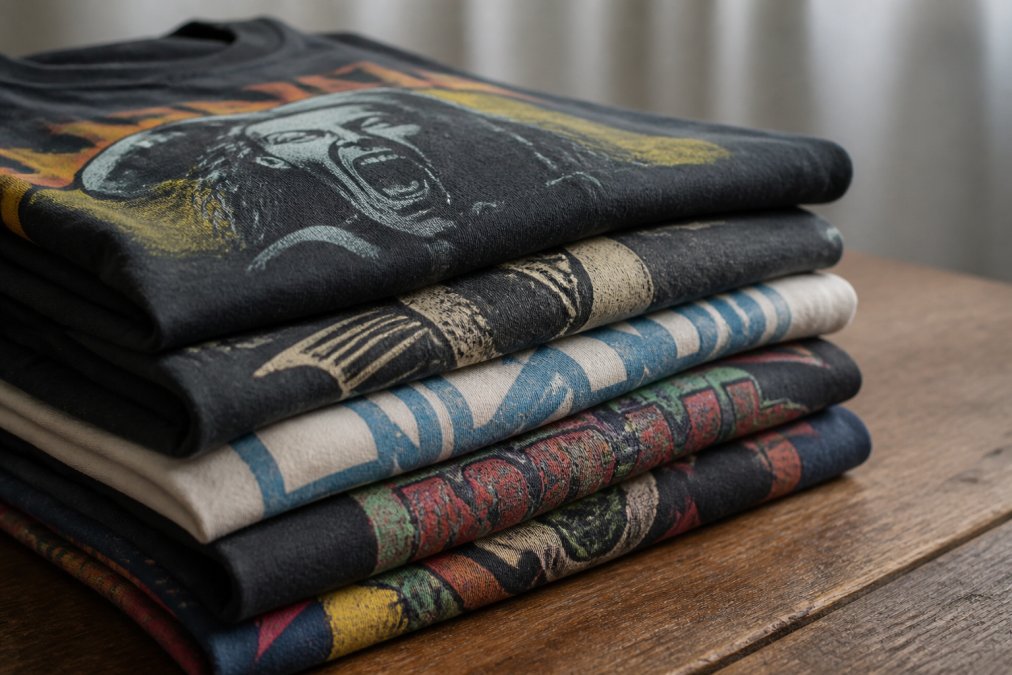
Prices start at $100 and climb significantly from there for rarer pieces. A genuine deadstock shirt from a legendary 1970s tour can reach several hundred dollars or more, depending on the band, the tour, and the condition of the garment.
WyCo is the right choice for collectors who understand what they are buying and want the real thing. It is not the right choice for someone who wants a wearable everyday shirt at a reasonable price point.
Vintage Band Shirt Price Guide: What to Expect to Pay
Pricing in the authentic rock shirt market spans a wide range depending on whether you are buying new licensed merchandise or genuine vintage pieces.
| Category | Typical Price Range | What Drives the Price |
|---|---|---|
| New officially licensed tees | Mid-range (varies by retailer) | Brand, retailer markup, fabric quality |
| Vintage-inspired premium graphic tees | Varies by brand | Design quality, apparel grade, artist licensing |
| Authentic vintage (1980s-1990s) | $100 to $300+ | Rarity, band, tour, condition |
| Authentic vintage (1970s deadstock) | $300 to $1,000+ | Extreme rarity, condition, historical significance |
| Limited edition licensed merch | Varies widely | Artist exclusivity, release quantity |
The gap between a $25 licensed shirt from a mainstream retailer and a $400 authentic vintage piece is not just price: it is category. One is apparel. The other is a collectible.
For Tim Cosgriff Art's current pricing on vintage-inspired classic rock tees, check the website directly.
How to Spot Fake Vintage Band Shirts Before You Buy
Knowing how to spot fake vintage band shirts is essential before spending serious money in the secondary market. Counterfeits range from obvious to genuinely deceptive, and the techniques for identifying them are learnable.
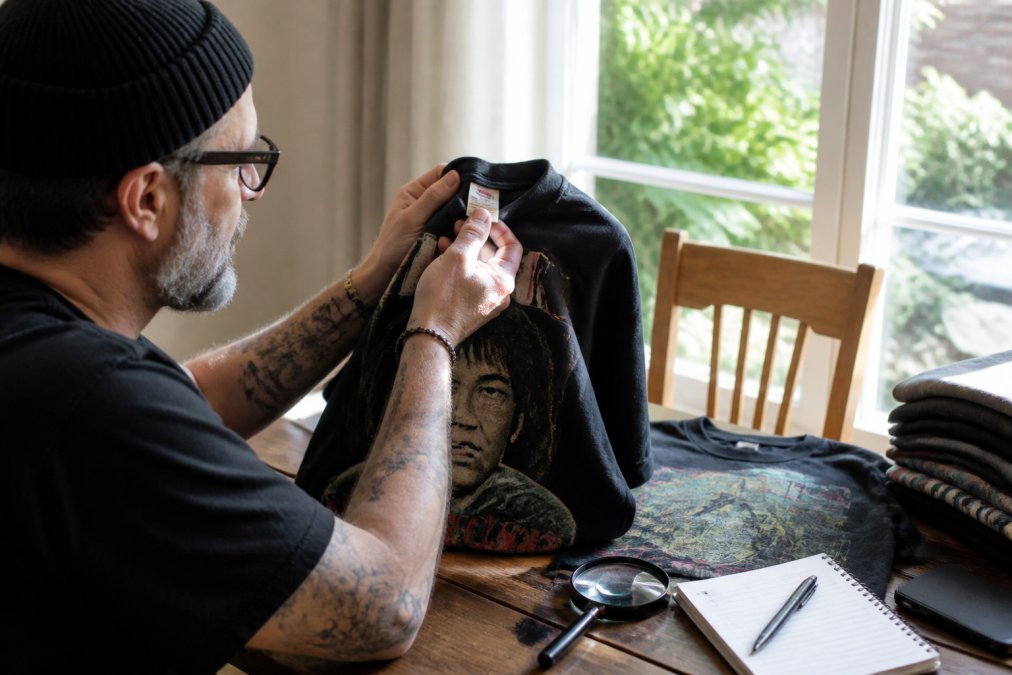
The most important rule: if a deal looks too good to be true on a "vintage" shirt, it almost certainly is. A genuine 1977 Fleetwood Mac tour tee does not sell for $30.
Check the Screen Print and Tag Details
The screen print is the first place to look when evaluating an authentic vintage shirt. Genuine prints from the 1970s through the 1990s used plastisol inks applied with older techniques that produce a specific look: slightly raised ink, visible dot patterns in the halftones, and a natural cracking or fading pattern that develops with age and washing.
Modern reprints typically show overly sharp, high-resolution graphics that look digitally printed rather than screen-printed, uniform color without tonal variation, ink that sits flat against the fabric, and cracking that looks artificial or uniform rather than organic.
The collar tag is equally revealing. Original band shirts from the 1970s and 1980s used specific tag manufacturers that are well-documented by collectors. Common tags include Fruit of the Loom, Hanes, and Screen Stars, each with specific fonts, logo designs, and construction details that changed over time. A shirt claiming to be from 1982 with a tag style not introduced until 1995 is a reprint.
Additional authentication checks:
- Check the seam construction: single-needle stitching on the collar and sleeves is period-correct for 1970s-1980s shirts
- Look at the fabric weight: original shirts were typically heavier cotton than modern blanks
- Examine the hem: original vintage shirts often have a single-fold hem rather than a double-fold
- Research the specific tour: verify tour dates against documented tour history
- Ask for provenance: reputable sellers like WyCo Vintage can often provide context on where a piece came from
Care and Preservation for Your Collection
Authentic rock shirts require specific care to maintain their condition. Most people destroy the print long before the fabric wears out.
The core rules for washing band shirts:
- Turn inside out before washing. This protects the screen print from direct friction.
- Cold water, always. Hot water accelerates ink cracking and fabric shrinkage.
- Gentle cycle or hand wash. High-spin cycles stress the seams and distort the garment shape.
- Skip the dryer. Air drying flat or on a hanger preserves the print and prevents heat-related shrinkage.
- Avoid harsh detergents. Enzyme-based detergents can break down plastisol inks. Use mild, dye-free detergent.
For genuine vintage pieces worth significant money, dry cleaning or professional textile conservation is worth the cost. Store high-value pieces flat or rolled rather than folded, and keep them away from direct sunlight, which fades both the fabric and the original print.
Frequently Asked Questions
How can you tell if a band shirt is authentic?
Authentic rock shirts carry officially licensed tags, clean screen-printed graphics with no ink bleeding, and manufacturer labels from known apparel brands. Bootleg shirts often skip the copyright notice, use thin or blurry prints, and have tags that look hand-applied or misspelled. For vintage concert tees, check the original print quality, single-stitch construction common before the mid-1990s, and the garment tag era. Buying from officially licensed retailers or established vintage specialists removes most of the guesswork.
What is the difference between vintage and reproduction band shirts?
A genuine vintage band shirt was printed and sold during the original tour or album era, often decades ago. Reproduction or vintage-inspired shirts replicate that aesthetic using modern garments and printing techniques. Reproductions are not bootlegs when properly licensed; they offer the classic rock look without the collector price tag. Authentic deadstock vintage shirts command higher prices because they are original artifacts, while licensed vintage-inspired tees give everyday fans a wearable, affordable alternative.
Are vintage band shirts worth the investment?
Rare, original concert tees from iconic tours can sell for hundreds of dollars and appreciate over time, making them legitimate collectibles. Condition, band significance, tour rarity, and original print quality all affect value. For most buyers, the appeal is personal rather than financial. If you want a shirt to wear regularly, a high-quality licensed or vintage-inspired tee delivers better value than risking damage to a collectible piece. Serious collectors should buy from reputable vintage specialists who authenticate each item.
How do I spot a fake vintage band t-shirt when shopping online?
Request clear photos of the collar tag, hem tag, and full front and back print before purchasing. Genuine vintage shirts from the 1970s through early 1990s typically feature single-stitch hems, screen prints with slight cracking from age, and tags from era-specific manufacturers. Artificially distressed reproductions sold as originals often have double-stitch hems, suspiciously even fading, and modern tag styles. Buying from established vintage band shirt specialists with detailed provenance descriptions significantly reduces the risk of receiving a fake.
Where do bands sell their official merchandise online?
Most major and legacy rock bands sell officially licensed apparel through their own artist store, through authorized merchandise suppliers, and through licensed retail partners. Dedicated platforms that partner directly with record labels and artist management guarantee authenticity. For classic rock bands, licensed specialty retailers often carry a broader back-catalog of album art and tour designs than the band's own current store, making them a strong option for fans chasing specific eras or graphic tees tied to particular albums.
Finding where to buy authentic rock shirts requires knowing which category matches your needs. Tim Cosgriff Art is the right starting point for fans who want premium, vintage-inspired graphic tees featuring iconic rock musicians, designed to be worn and enjoyed rather than stored in a drawer. Browse the current collection at Tim Cosgriff Art and find a wearable tribute to the music that matters to you.
This article was written using GrandRanker