
Table of Contents
- The Core of Rory Gallagher's Guitar Tone
- What Guitar and Pickups Did Rory Gallagher Use?
- The Best Treble Booster Pedals for That Sound
- Vox AC30 Settings and the Amplifier's Role
- Effects and Signal Chain Order
- Playing Technique and Volume Knob Dynamics
- Why Rory Gallagher Guitar Tone Still Matters
- Frequently Asked Questions
Last Updated: September 6, 2026
The Core of Rory Gallagher's Guitar Tone
Rory Gallagher guitar tone is the sound of a battered 1961 Fender Stratocaster pushed through a cranked Vox AC30, with no effects other than a treble booster and sheer physical intensity. It is a tone built on tube saturation, single coil pickups, and the dynamic response of a player who treated his volume knob as a master effect. Few guitarists have ever matched the combination of biting edge and smooth sustain that Gallagher achieved night after night.
For the uninitiated, Rory Gallagher guitar tone represents a masterclass in simplicity. The signal chain is famously minimal, yet the harmonic richness he coaxed from vintage circuitry remains a benchmark for blues-rock players. At Tim Cosgriff Art, we celebrate these legends of classic rock, and understanding what made Gallagher's sound so iconic deepens the appreciation for the music and the era.
Below, we'll break down the exact gear, the Vox AC30 settings, the signal chain order, and the playing technique that produced one of the most recognizable lead tones in rock history.
What Guitar and Pickups Did Rory Gallagher Use?
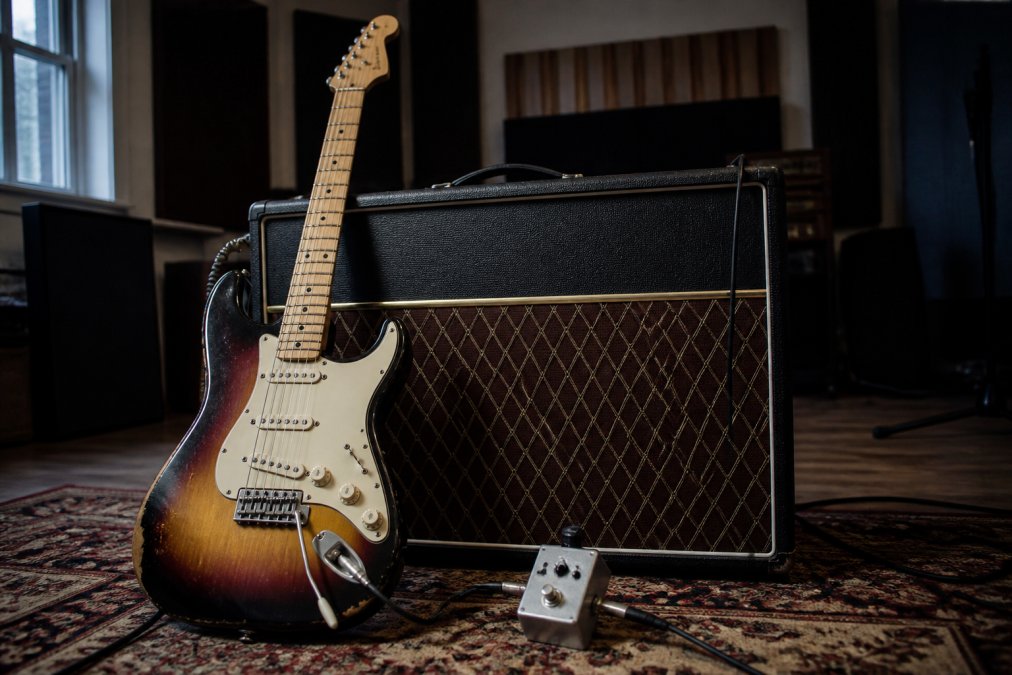
The foundation of Rory Gallagher guitar tone is his legendary 1961 Fender Stratocaster, a sunburst model he bought second-hand in Belfast and played until the wood was worn bare. Its single coil pickups are the defining element, providing the clarity and articulation that cuts through a mix without needing high gain (fender.com). Gallagher never relied on humbuckers; the inherent glassiness of single coils gave his sound its signature frequency response.
The pickups were not heavily modified, which is the crucial lesson. Many players chase his tone by swapping in vintage-spec pickups, but the real secret is how the guitar interacts with a cranked amplifier. A Stratocaster's pickups into a tube amp at the edge of breakup produces the mid-range punch and speaker breakup that define his rhythm and lead tones. The guitar's tone control was almost always wide open, letting the full harmonic spectrum hit the amp.
The Best Treble Booster Pedals for That Sound
The single most important pedal in replicating Rory Gallagher guitar tone is a treble booster, specifically the Dallas Rangemaster circuit. This vintage circuitry is not an overdrive or distortion; it is a clean boost that aggressively shapes the frequency response, cutting low end and pushing the mid-range and treble into the amplifier's front end (analogman.com). This is what drives the amp into natural tube saturation while preserving pick attack.
For players today seeking the best treble booster pedals, several options capture that classic Rangemaster character. The Analog Man Beano Boost is a faithful recreation with added controls for modern flexibility. The Catalinbread Naga Viper offers a wider range of gain and treble shaping. For a budget-friendly alternative, the MXR Micro Amp can be set as a clean boost, though it lacks the specific mid-range punch of a true treble booster. When setting any of these, run them with the gain high and the tone control set to add brightness, letting the pedal push the amp rather than adding its own distortion.
Vox AC30 Settings and the Amplifier's Role
The Vox AC30 is the sonic anchor of Rory Gallagher's tone, but the story doesn't end there. While the 'Marshall Phase' is often mentioned in passing, a deep dive reveals a distinct second chapter in his live sound that most guides overlook. Understanding both phases is key to unlocking the full spectrum of his tone.
The Vox AC30 Phase: Chime and Headroom
Gallagher's primary live rig for much of his career was a Vox AC30, specifically the top-boost model. The goal with this amp is not preamp distortion, but power amp and speaker breakup. He ran the amp extremely loud, often with the volume on the Top Boost channel pushed to maximum, relying on the EL84 power tubes and the Celestion Blue speakers to compress and distort naturally (voxamps.com).
A practical starting point for Vox AC30 settings is:
- Top Boost Channel: This is the channel he used for his signature lead tone.
- Bass Control: Set low, around 9 o'clock. This keeps the low end tight and prevents muddiness when the treble booster pushes the front end.
- Treble Control: Set high, around 2 to 3 o'clock. This is where the signature 'chime' lives, and it provides the upper-mid presence that cuts through a mix.
- Volume Control: This is the master of your tone. It needs to be pushed past 12 o'clock, and ideally to 3 o'clock or higher, to get the power tubes singing. The amp's natural compression and harmonic distortion at these volumes are irreplaceable.
- Master Volume (if present): Wide open. The goal is to let the power amp do the work, not the preamp.
A common mistake is using the Brilliance or Normal channels. The Top Boost channel's extra gain stage and tone stack are essential for achieving that aggressive, cutting tone. The interaction between the treble booster and the amp's input stage is where the magic happens.
The 'Marshall Phase': A Different Kind of Push
In the late 1970s and early 1980s, Gallagher began incorporating Marshall amplifiers into his live rig, often running them in tandem with his Vox. This is a less-covered but crucial part of his sound evolution. The Marshall phase wasn't a replacement but an addition, providing a thicker, more aggressive low-mid grind that filled out the sound for larger venues.
A common setup was a 100-watt Marshall Super Lead (Plexi) head running into a 4x12 cabinet, alongside the Vox AC30. The Marshall was typically set with:
- Presence: High, around 7 or 8, to add sparkle and cut.
- Bass: Moderate, around 5, to add girth without flab.
- Middle: High, around 7, to push the guitar forward in the mix.
- Treble: High, around 7, to maintain articulation.
- Volume: Cranked to 8 or higher. The Marshall's power amp distortion is richer and has more low-end thump than the Vox.
The key difference is the frequency response. The Vox AC30 has a distinctive upper-mid 'chime' and a tighter low end, while the Marshall has a thicker, more muscular mid-range and a punchier low end. When run together, the Vox provides the top-end sparkle and articulation, while the Marshall fills out the bottom and adds a raw, aggressive edge. This dual-amp setup is a more complex but rewarding path for players who want to explore the full range of Gallagher's live sound.
Dialing in for Your Rig
Whether you're using a single AC30 or a dual-amp setup, the fundamental principle remains the same: the amp must be loud enough to break up naturally. If you're playing at bedroom volumes, you won't be able to achieve this with a tube amp alone. You'll need an attenuator (like a Weber Mass or a THD Hot Plate) to get power amp distortion at lower volumes, or you'll need to rely on a pedal that emulates that power amp saturation.
For players using digital modelers, the 'Marshall Phase' is a fantastic way to add depth to your patch. Start with a model of a Vox AC30 Top Boost and a Marshall Super Lead. Run them in parallel, blending the Vox's chime with the Marshall's grind. This approach is a unique angle that most online guides miss, but it's essential for capturing the full power of his live sound.
Effects and Signal Chain Order
A common mistake is assuming Gallagher used a wall of effects. In reality, his signal chain order was remarkably sparse: guitar into treble booster into amp. He famously avoided effects like chorus and heavy reverb, relying on the natural ambience of the room and the amp's own characteristics. This minimal approach is why his tone remains so immediate and dynamic.
For players replicating this sound, the signal chain order should be strictly maintained. Place the treble booster first in the chain, directly after the guitar. If you must add other effects, keep delay and modulation in the amplifier's effects loop or after the booster in the chain. Adding a delay pedal after the booster is acceptable for solos, but it should be set subtly. The key is gain staging: the booster pushes the amp, and the amp does the work. Adding a distortion pedal before the booster will muddy the frequency response and ruin the articulation.
Playing Technique and Volume Knob Dynamics
Gear alone does not explain Rory Gallagher guitar tone; the volume knob manipulation and physical playing technique are equally critical. Gallagher treated his guitar's volume control as a channel switcher. Rolling the volume back to seven or eight cleans up the tone for rhythm parts, while rolling it to ten pushes the amp into full overdrive for leads. This dynamic response requires a loud, clean amp that reacts to the guitar's output.
The pick attack is another essential component. Gallagher played with a heavy hand, often using a thumb pick and fingers, which produces a percussive quality. This articulation is what makes his rapid-fire licks sound so defined. Players should practice striking the strings harder to push the amp into tube saturation rather than relying on a pedal for more gain. The subtle interplay between the volume knob and the guitar's tone control allows for a vast range of expression from a single setup.
Why Rory Gallagher Guitar Tone Still Matters
Decades after his peak, Rory Gallagher guitar tone remains the gold standard for blues-rock players because it proves that tone comes from the player, not the pedalboard. In an era of digital modeling and plugin presets, his sound is a reminder that a simple setup of a Strat, a treble booster, and a Vox AC30 can produce an infinite range of expression. The lesson is timeless: focus on the amp's response and your hands, not on accumulating gear.
This philosophy resonates beyond just guitar players. For fans of classic rock, the raw, unprocessed nature of his sound represents an authenticity that is rare today. It connects to a broader appreciation for the craft of music, something that vintage-inspired culture celebrates. Wearing a tribute to such a legend is a way to express that same passion for authentic rock and roll.
Frequently Asked Questions
How did Rory Gallagher achieve his signature treble-boosted sound?
Rory Gallagher's core sound came from pushing a cranked Vox AC30 with a Dallas Rangemaster treble booster into natural tube saturation. The booster added a biting edge and rich harmonics that cut through the mix. He combined this with single coil pickups and relied on his guitar's volume knob to clean up the tone or push it into overdrive, creating his signature smooth sustain and dynamic response.
Which amplifier was most essential to Rory Gallagher's live tone?
While he used various amps over his career, the Vox AC30 was the backbone of his sound, especially during his early solo years. He favored the EL84 tube-driven combo for its immediate response and speaker breakup at high volumes. For modern players, getting a Vox AC30 and running a treble booster into the front end is the most direct route to capturing that classic Rory Gallagher guitar tone.
What is the best treble booster pedal for getting a Rory Gallagher-style tone?
The Dallas Rangemaster is the original circuit Rory used, and many modern recreations like the Analog Man Beano Boost or the Naga Viper capture that same vintage circuitry. When choosing from the best treble booster pedals, look for one that adds output impedance and a pronounced mid-range punch rather than just a harsh EQ. This interaction with the amp's input stage is what creates that aggressive, yet smooth, lead tone.
What Vox AC30 settings did Rory Gallagher use to get his tone?
Rory's approach to Vox AC30 settings was simple: he cranked the volume to push the tubes into natural harmonic distortion. He typically ran the treble high and the bass low to get that cutting sound. Because he relied on the amp and booster for drive, his tone control and pick attack did the rest, letting him go from clean boost to full overdrive with just his guitar's volume knob.
Replicating the sound of a legend is a challenge, but it starts with understanding the fundamentals of gear and technique that we have outlined here. At Tim Cosgriff Art, we are dedicated to the icons of classic rock, offering vintage-inspired apparel that lets you wear your music history. Our high-quality graphic tees are designed for fans who value timeless aesthetics and comfortable, durable wear. Continue shopping to find a tribute that matches your passion for the greats.